| Theme: | Stereotypes, prejudice and discrimination |
|---|---|
| Learning Area: | English – Health and Physical Education (HPE) [contentblock id=iconinfo] |
| Age Group: | Primary Upper (10-12 years) |
| Resource Type: | Posters and artwork |
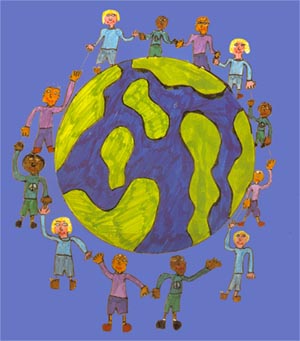
| Stimulus Name: | A Better World, Year 4 student, Griffith Public School, NSW |
Students experience feelings of being kept out of a group. The Year 4 student who painted the stimulus work wrote of the importance of children and adults of different backgrounds and colours playing, learning and working together to make the world a better place to live in.
This activity serves as a useful introduction for examining the behaviour of people who feel cut off or blocked from the mainstream of Australian life. It is also valuable for exploring human relationships within the classroom.
An adequate amount of open space is needed for this exercise.
Ask a group of 8-10 students to form a tight circle and lock arms. Another student outside the group tries as hard as he/she can to break into the group. When and if this student successfully breaks into the circle, he/she becomes part of that group. Another person then takes his/her place outside and tries to break in. Each student takes a turn being outside the group.
Many different feelings might be generated by this game. The person on the outside will have a sense of isolation, of being left out. After a few unsuccessful attempts to break in, the outsider might show considerable aggression, clown around, withdraw, act uninterested, or respond in a variety of other ways. The group might feel united in their common task or conceivably even take pity on the outsider and let him/her in the circle.
Afterwards, discuss the feelings and behaviour that emerged during the game: how it felt to be kept out; how it felt to fail and/or succeed; what techniques were used by various participants to gain entrance to the group. You might want to compare the outsider’s feeling and behaviour with those of people in our society who find themselves outside.
(Adapted from: Shrank, Jeffery, Teaching human beings, Boston, Beacon Press, 1972.)
The teacher may need to pose some hypothetical situations to help students explore reasons for discrimination.
More lesson ideas: View by learning area » : View by theme » : View by age »
For additional activities dealing with prejudice and discrimination refer to:
The Prejudice Book, Activities for the Classroom
Outside the In-Group from
The Prejudice Book- Activities for the Classroom,
David Shiman and Barbara McLean
Courtesy of the Alfred Dreyfus Anti-Defamation Unit of B’nai B’rith, NSW
Date: 15 June 2001
Racism. No Way!
Racism. No Way! is committed to providing accessible content for all users. This includes those with physical and cognitive disabilities, as well as anyone using assistive technology.
This website adheres to the World Wide Web Consortium’s (W3C) Web Content Accessibility Guidelines 2.1 Web Content Accessibility Guidelines 2.1 (WCAG 2.1) at the AA level.
This website utilizes an accessibility interface that allows persons with specific disabilities to adjust the website’s UI (user interface) and design it to their personal needs.
An AI-based application runs in the background of the website and constantly optimizes its accessibility level. This application remediates the website’s HTML, adapts Its functionality and behaviour for screen-readers used by people who are blind or have low vision, and for keyboard functions used by individuals with motor impairments.
Screen-reader and keyboard navigation
Our website implements the ARIA attributes (Accessible Rich Internet Applications) technique to optimise screen-reader functionality.
These adjustments are compatible with all popular screen readers, including JAWS and NVDA.
Shortcuts such as “M” (menus), “H” (headings), “F” (forms), “B” (buttons), and “G” (graphics) can be used to jump to specific elements.
Disability profiles supported in our website
Additional UI, design, and readability adjustments
Browser and assistive technology compatibility
Racism. No Way! uses a wide range of browsers and assistive technologies. Supported systems include: Google Chrome, Mozilla Firefox, Apple Safari, Opera and Microsoft Edge, JAWS and NVDA (screen readers), both for Windows and for MAC users.
Notes, comments, and feedback
We continually improve accessibility by adding, updating and improving options and features, as well as developing and adopting new technologies.
At times, we link to content or documents from third parties. This content may not adhere to the standards we follow.
For any assistance, please contact us by email
